About the author
Aaron Tunnicliff is Head of Pre-sales and Engineering at Ideal, helping customers of all sizes to choose the right technological solutions for their current and future needs.
At Ideal, we’ve delivered the UK’s first commercial deployment of PoE-powered workspaces, demonstrating that desks, task lighting and workplace technology can become intelligent, centrally managed, network-powered endpoints.

Voice. Video. Wireless. CCTV. IoT sensors. Lighting. One by one, technologies such as this that once relied on dedicated infrastructure have converged onto the enterprise network, simplifying deployment while creating smarter, more connected buildings.
PoE (Power over Ethernet) isn’t new, but it is changing how buildings are designed. As more technologies converge, organisations are beginning to replace fragmented electrical infrastructure with a single intelligent platform capable of powering, managing and measuring the workplace.

How did we engineer the UK's first commercial PoE workplace deployment and what did we learn? Request the technical whitepaper to learn more.

The demand for PoE-powered workspaces isn’t being driven by manufacturers, it’s being driven by changing business priorities.
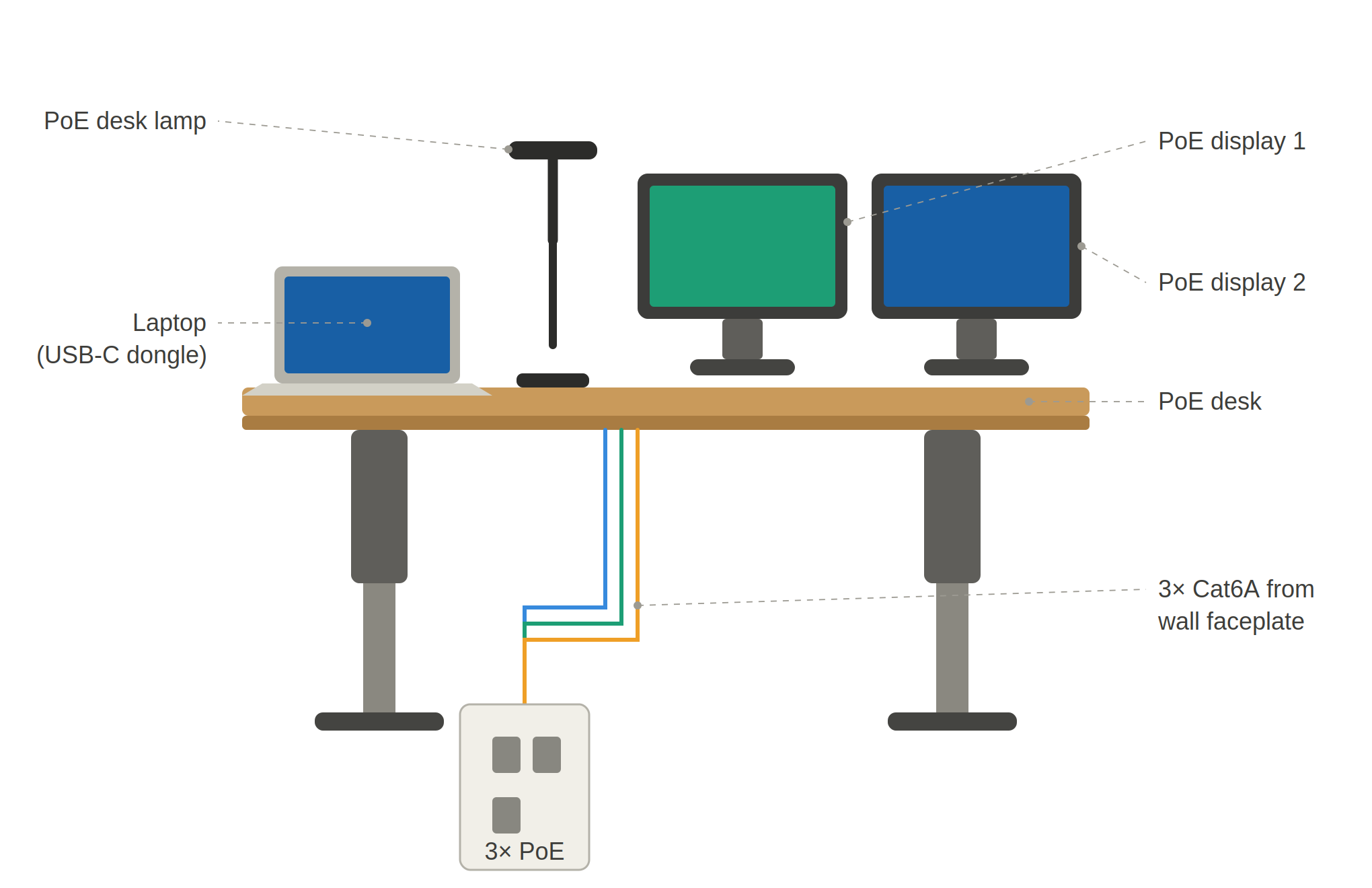
Hybrid working changed how organisations think about office space. Workplaces are expected to be more flexible, more sustainable and easier to adapt than ever before. Office layouts change regularly, teams move frequently, and every square metre of space is expected to work harder. Traditional electrical infrastructure wasn’t designed with that level of flexibility in mind.
A PoE-powered workspace takes a completely different approach: By delivering both power and connectivity through structured network cabling, entire workspaces become managed devices rather than standalone electrical installations. Workplace moves become simpler, infrastructure costs reduce and organisations gain a level of operational flexibility that traditional office design simply cannot achieve.
PoE-powered workspaces have been largely confined to technology showcase environments, proving what was technically possible but rarely being deployed in live customer environments.
Ideal recently designed and delivered the UK’s first commercial PoE-powered workspace deployment outside of a vendor demo facility, bringing together enterprise networking, structured cabling, intelligent workplace technology and Power over Ethernet into a single converged solution.
Delivering a PoE-powered workspace requires expertise across networking, structured cabling, workplace technology and power distribution, bringing together disciplines that have traditionally operated independently.
Working alongside leading technology partners, we created a fully integrated workspace for a leading global charity in London, where our PoE installation, all powered by a single network conection, included:
Using just a small number of structured Ethernet connections, the workspace becomes another intelligent endpoint within the enterprise infrastructure, reducing reliance on traditional electrical installations while maintaining the flexibility expected from a modern office.
PoE enables Ideal’s Seymour Telemetry Solution to immediately analyse, device usage, energy usage and much more and integration with other analytics tools can transform smart decision-making.
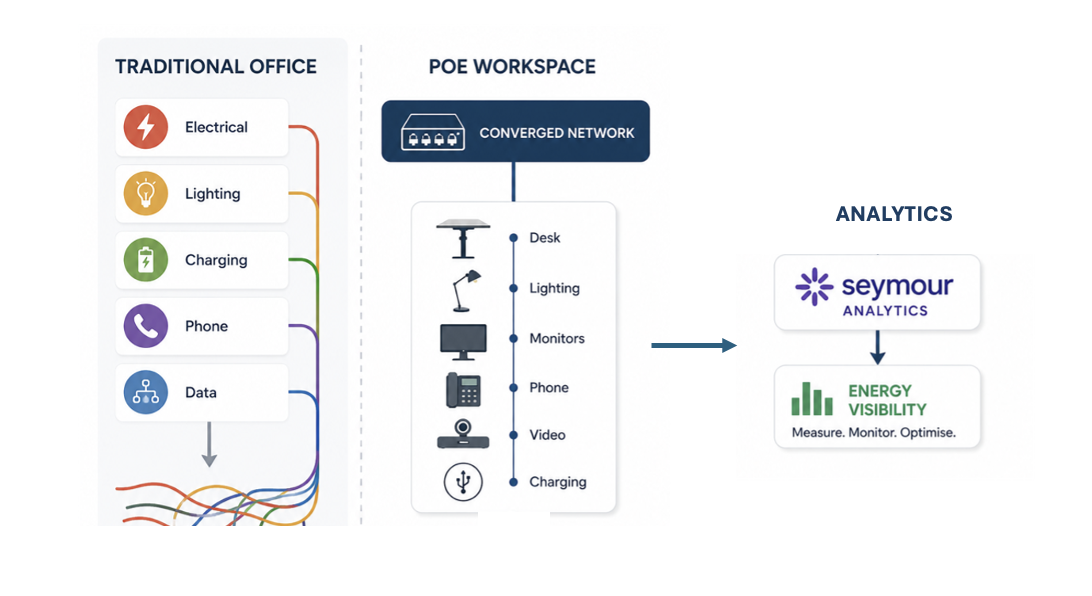
The practical benefits quickly became clear, instead of separate electrical installations and multiple specialist trades, power and data are delivered through the same structured cabling infrastructure already managed by the IT team.
As more technologies move onto the network, organisations gain a consistent approach to deployment, management and lifecycle support across their buildings.
For organisations already investing in PoE lighting, intelligent sensors, room booking systems, environmental monitoring and connected workplace technology, PoE-powered workspaces represent a natural next step rather than a standalone innovation. For the first time, IT and Facilities are working from the same infrastructure rather than managing separate technology and electrical estates.
While PoE is changing today’s workplace, Fault Managed Power (FMP) will extend that same converged approach to an even broader range of higher-powered workplace technologies, accelerating the transition towards fully network-powered buildings.
FMP enables significantly higher levels of power to be delivered safely over structured cabling, opening the door to an even broader range of workplace technologies operating from the network. As standards continue to mature and adoption increases, FMP will enable organisations to extend the same converged approach beyond desks to technologies that have traditionally relied on dedicated electrical infrastructure.
By designing workplace infrastructure around the network today, organisations will be perfectly positioned to take advantage of the additional capabilities FMP will unlock tomorrow.
At Ideal, we’re already working alongside leading technology partners to understand how these emerging standards can be incorporated into future Smart Building designs, ensuring customers invest in infrastructure that evolves alongside the market.
Powering the workspace is only part of the story; understanding how that workspace performs is where the real value lies.
As businesses continue to focus on sustainability, operational efficiency and ESG reporting, knowing how much energy is being consumed, and where, becomes just as important as reducing consumption in the first place.
By moving workplace power onto the network, organisations don’t simply simplify infrastructure, they create the opportunity to understand, manage and optimise energy consumption in ways that traditional electrical installations simply cannot.
Aaron Tunnicliff is Head of Pre-sales and Engineering at Ideal, helping customers of all sizes to choose the right technological solutions for their current and future needs.
 Aaron Tunnicliff, Head of Pre-sales and Engineering at Ideal
How did we engineer the UK's first commercial PoE workplace deployment and what did we learn? Request the technical whitepaper to learn more.